• youtube
  • twitter
  • google plus icon
  • facebook
  • logo linkedin
  • La historia de cómo Perú derrotó al terrorismo

    La historia de cómo Perú derrotó al terrorismo

    Como se menciona en el último artículo de Hernando de Soto, La Disyuntiva Colombiana: Los Terroristas o Sus Ciudadanos, aquí está la historia  de cómo el Perú venció al terrorismo. Descargar PDF. Read More
  • The 2017 Global Award for Entrepreneurship Research goes to Hernando de Soto

    The Global Award for Entrepreneurship Research is the most prominent international award in entrepreneurship research with a price sum of EUR 100,000. De Soto’s analyses have had tremendous influence on policy throughout the world and were a main source of inspiration for the World Bank’s Doing Business program. Read More
  • 2017 Award Winner

    Hernando de Soto Peru  Institute for Liberty and Democracy For developing a new understanding of the institutions that underpin the informal economy as well as the role of property rights and entrepreneurship in converting the informal economy into the formal sector.   Read More
  • Undogmatic thinking

    Q&A with economist Hernando de Soto Polar It is not every day that a world-renowned economist touches down on Lebanese soil,but it should not surprise that such a formidable economist could deliver a presentation less than 24 hours after arriving in Beirut for the first time in his life. It might be expected that he would start with an exercise in affinity, by saying nice Read More
  • "The world’s most important living economist”

    Former US President Bill Clinton has described Hernando de Soto as “the world’s most important living economist.” Mr. de Soto visited Sweden in May 2017 to receive the Global Award for Entrepreneurship Research. In this pod he takes the listeners into the world where he grew up and tells us why he returned to Peru to start his today renowned think tank the Institute for Read More
  • Un Año Nuevo sin conflictos sociales

    Hernando de Soto se reunió con 2,000 dirigentes de los Comités de Autodefensa (CADs) del Perú en Huanta-Ayacucho durante la tercera semana de diciembre. El economista sostuvo que, mientras el terrorismo tiñe de sangre al mundo, en nuestro país vivimos en paz gracias a los CADs, quienes fueron los verdaderos artífices de la derrota del terrorismo en el Perú. De Soto sostuvo que una gran solución a la problemática Read More
  • First Ever Global Blockchain Business Council (GBBC) Launching in Davos

    Formed by The Bitfury Group in collaboration with Covington - Major Launch Event Will Bring Together Global Leaders and Innovators: SAN FRANCISCO, CA – January 4, 2017 – The Bitfury Group, the leading global full-service Blockchain technology company, announced today that in collaboration with international lawfirm Covington, it is launching the first ever Global Blockchain Business Council (GBBC) around the World Economic Forum 2017 Annual Meeting Read More
  • Georgia to Store Real Estate Documents in Blockchain System with Bitfury Group and Hernando de Soto

    The country of Georgia will introduce Blockchain technology in 2017 to enable citizens store and receive real estate extracts according to a report in Caucasus Business Week. Minister of Justice Tea Tsulukiani told the Business Contract. Read More
  • 1
  • 2
  • 3
  • 4
  • 5
  • 6
  • 7
  • 8

The ILD

The Institute for Liberty and Democracy (ILD), led by Peruvian economist Hernando de Soto, works with developing countries to implement property and business rights reforms that provide the legal tools and institutions required for citizens to participate in the formal national and global economy. ILD works toward a world in which all people have equal access to secure rights to their real property and business assets in order to pull themselves—and their countries—out of poverty.

After years of research, the ILD began to understand that in Peru democracy had essentially been reduced to the act of voting. Because voters have no mechanisms at their disposal to register their reaction to new laws or policies, and the authorities do not have peaceful and organized means to gather public opinion or to channel existing initiatives by citizens, political participation ends at the ballot box. Peruvians thus hand over a virtual “blank check” to their elected officials, who, in turn, convert this check into thousands of laws and decisions that significantly affect the life of the people —without consulting or being accountable to them. And so, even when politicians govern with the best interests of the electorate in mind, they do so in ignorance and on the basis of biased information provided by those with special access to power.

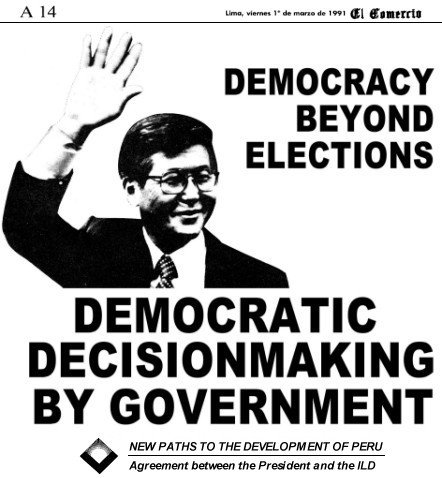
On February 26, 1991, President Fujimori, in a nationwide televised address, subscribed the ILD diagnosis of Peruvian democracy and announced that he was enacting the Law for Democratic Decision-Making by Government that had been drafted for him by the ILD. He told his audience that for the first time in history Peruvians would have the following rights: to know the contents of laws before the Executive Branch or its agencies enacted them; to express their opinions by submitting their comments or by participating in public hearings when laws were being formulated; to identify public officials drafting laws and hold them accountable. In addition, citizens and the media would have, among other things, the right to have access to government controlled information; challenge arbitrary laws quickly via clearly defined procedures; consider requests as resolved in their favor if they had not been addressed within the time allotted by law; have the right to initiate referendums and participate in government advisory committees.

In March 1991, President Fujimori, under pressure from his own ministers and the nation’s mercantilist sectors, enacted a law that had been watered down significantly. Caretas, Peru’s leading newsmagazine, summarized the episode in this way: “The ILD’s project was the object of a mass attack from all fronts.” The opponents of the law were, Caretas pointed out, “those whose interests are affected by the pre-publication of laws. Namely, those who have access to government through political influence, power, bribery or kinship. [Not to mention] the very people who hold the power to make laws, which includes ministers, directors...”

In spite of this political setback to the ILD’s reform efforts, the consensus among the people concerning the ILD proposals remained favorable. Surveys indicated that 81% of the population supported the proposals to democratize government decision-making. In view of such overwhelming popular support, the ILD decided to wait for a new window of opportunity. As it turned out, President Fujimori himself opened that window less than two years later.

Contact Us
P.O. Box 18-1420  
(511) 222-5566