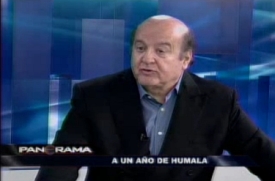
 22 July 2012 - Roxana Cueva interviews Hernando de Soto on Panorama on President Ollanta as well as the role of property, or the lack thereof, in the violence in Conga and other mines.
(The interview is in Spanish)





22 July 2012 - Roxana Cueva interviews Hernando de Soto on Panorama on President Ollanta as well as the role of property, or the lack thereof, in the violence in Conga and other mines.
(The interview is in Spanish)
 22 de julio del 2012 - El economista también afirmó que a Ollanta Humala “le ha tocado ser presidente en las mismas circunstancias que a Fujimori en los noventa”
El economista Hernando de Soto consideró que el presidente Ollanta Humala se ha manejado con “sensatez” durante el primer año de su Gobierno. “Hay una sensación de madurez desde mi punto de vista, la buena voluntad que siempre se le ha reconocido, la flexibilidad que es crucial para un político. Ha manejado los asuntos como ha podido”, dijo.
3 July 2012 - Host of Mira Quién Habla, Cecilia Valenzuela, interviews Hernando de Soto on the Arab Spring. Part 1 and 2 below.
(The interview is in Spanish)
 By Lauren E. Bohn and Tim Lister , CNN | June 29, 2012
(CNN) — Amid all the furor about the seemingly omnipotent military in Egypt, the disbanded Islamist-dominated parliament and the debate over whether the Muslim Brotherhood will ban beer and bikinis, it's tempting to mutter, "It's the economy, stupid."
In 18 months of upheaval, all Egypt's economic indicators have headed south.
Growth is a projected 1.5% this fiscal year, far too feeble to provide a young and rapidly growing population with jobs (80% of Egypt's population is under age 30). Unemployment, one of the engines of the revolution, is estimated to be as high as 25% among the young. Tourism revenues have fallen sharply, and foreign reserves have dwindled to $15 billion. According to the United Nations, some 40% of Egyptians live below the poverty line; 14 million people subsist on less than $1 a day. Institutions are chronically weak and corruption is endemic.
President-elect Mohamed Morsi has his hands full.
Many critics say the military has handed Morsi a neutered presidency doomed to fail. But economists who have dealt with the Muslim Brotherhood's economic team describe the team as pragmatic, well-prepared and favorable to the free market.
 Why a win by the Muslim Brotherhood’s presidential candidate could be the best thing for Egypt’s economy.
7 June 2012 - As Egyptians prepare to vote in the upcoming final round of presidential balloting on June 16 and 17, pictures of yet more protests in Tahrir square are doing little to reassure foreign investors and other observers about the future of Egypt. Bond markets are betting that the Egyptian revolution will end in tears. They may yet be proved wrong.
The most recent round of protests began after what many Egyptians saw as an overly-lenient verdict in the trial of former President Hosni Mubarak. Although Mubarak was sentenced to life in prison for failing to protect the life of Egyptian citizens, none of his henchmen were found directly responsible for the deaths of some 900 protestors, nor was Mubarak found guilty of corruption.
 By Hernando de Soto
January 29, 2012 - The world economy is made up of many tiny parts that are useful only when we combine them into more complex wholes. The higher the value of these aggregations, the more economic growth. Humanity’s achievements – from the 120 ingredients of my clock to the countless financial deals and developments that produced the internet and flight navigation systems – all result from joining people and things to each other.
That’s why western capitalism has triumphed for the past 150 years: it gave us the best knowledge to explore economic combinations. Capitalism does not need to be re-thought or re-invented; it simply has to be re-discovered.
Want to work an economic miracle in Egypt? Hernando de Soto has some ideas.
INTERVIEW BY CHRISTIAN CARYL | JANUARY 12, 2012
In 2004, Peruvian economist Hernando de Soto and his think tank, the Institute for Liberty and Democracy, were asked to come up with ideas for revitalizing the Egyptian economy. In an interview with FP’s Christian Caryl, he argues that those ideas remain more topical than ever.
Foreign Policy: Not many economists have been targeted by terrorists. Why did the Peruvian insurgent group Shining Path put you and your colleagues on its hit list?